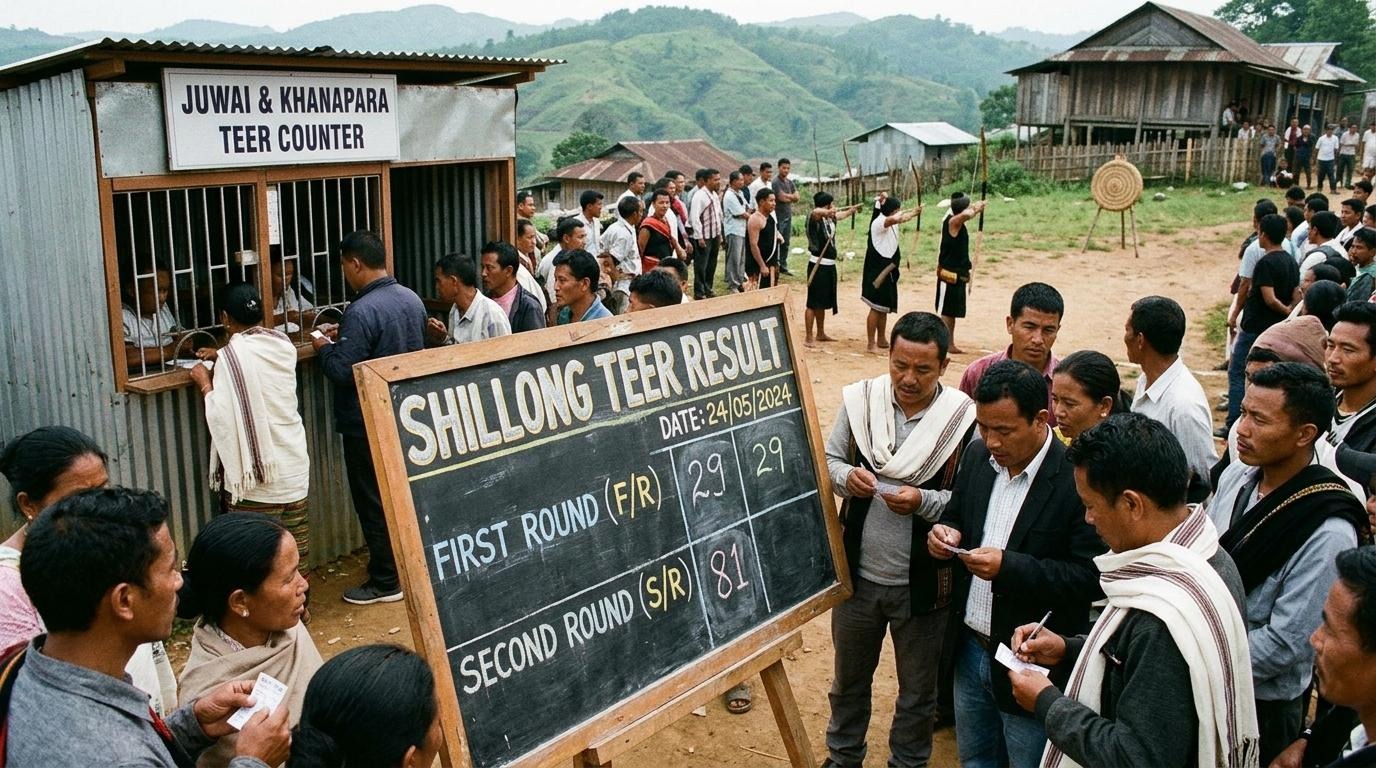
The state of Meghalaya in Northeast India is home to one of the most intriguing archery-based traditional games in the world: Shillong Teer. Organised daily by the Khasi Hills Archery Sports Association, this unique lottery seamlessly blends athletic skill with number prediction. Deeply embedded in the cultural heritage of the Khasi hills, it provides thousands of local participants with a legal, regulated form of daily entertainment.
How the Archery Game Works
Unlike standard digital lotteries that rely on randomized algorithms, the outcome of Shillong Teer is determined entirely by physical archery precision.
The game takes place at the historic Polo Ground in Shillong and is divided into two distinct daily rounds:
- First Round (FR): A total of 50 archers from local sports clubs shoot 30 arrows each at a cylindrical bamboo target placed 50 yards away.
- Second Round (SR): The archers assemble once again to shoot 20 arrows each at the target.
Calculating the Winning Number
Once all arrows hit the target, officials collect and count the total number of striking arrows for that round. The winning number is determined by taking the last two digits of the total count.
Example: If 847 arrows hit the target in the first round, the official winning outcome for that round is 47. Participants place predictions on numbers ranging from 00 to 99 prior to the start of the round.
Daily Schedule and Timings
The archery session takes place six days a week, from Monday through Saturday, with operations pausing on Sundays.
| Round | Archery Start | Result Time | Arrow Count |
|---|---|---|---|
| First Round (FR) | 3:30 PM IST | 3:45 PM IST | 30 arrows per archer |
| Second Round (SR) | 4:30 PM IST | 4:45 PM IST | 20 arrows per archer |
To verify daily predictions and track outcomes for both rounds, participants frequently look up the live shillong teer result to compare numbers immediately following official counts.
Dream Interpretations and Target Predictions
A unique cultural dimension of the game is the tradition of dream numerology. Many local punters interpret their nightly dreams to select their two-digit picks for the upcoming day:
- Seeing a snake in a dream is commonly linked to the number 07.
- Dreaming of a man and woman together often prompts picks like 56 or 65.
- Dreams involving water, travel, or flight carry their own distinct historical associations.
Beyond dream analysis, frequent players maintain detailed historical charts to track “house,” “ending,” and “common” numbers across past weeks to refine their strategies.
Regional Variations and Economic Impact
While the Shillong game remains the most prominent, neighboring regions in Northeast India feature similar archery lotteries:
- Khanapara Teer: Held near Guwahati, Assam, adhering to similar structural rules.
- Juwai Teer: A popular variant conducted in the Jaintia Hills region.
Regulated under the Meghalaya Amusements and Betting Tax Act, Teer generates essential revenue for the state while supporting local archers, licensed ticket counter staff, and small business vendors.
Conclusion
Shillong Teer represents a rare bridge between indigenous tribal sports traditions and modern recreational prediction games. By preserving historic archery practices while fostering community engagement, it remains an integral part of daily life across Meghalaya.